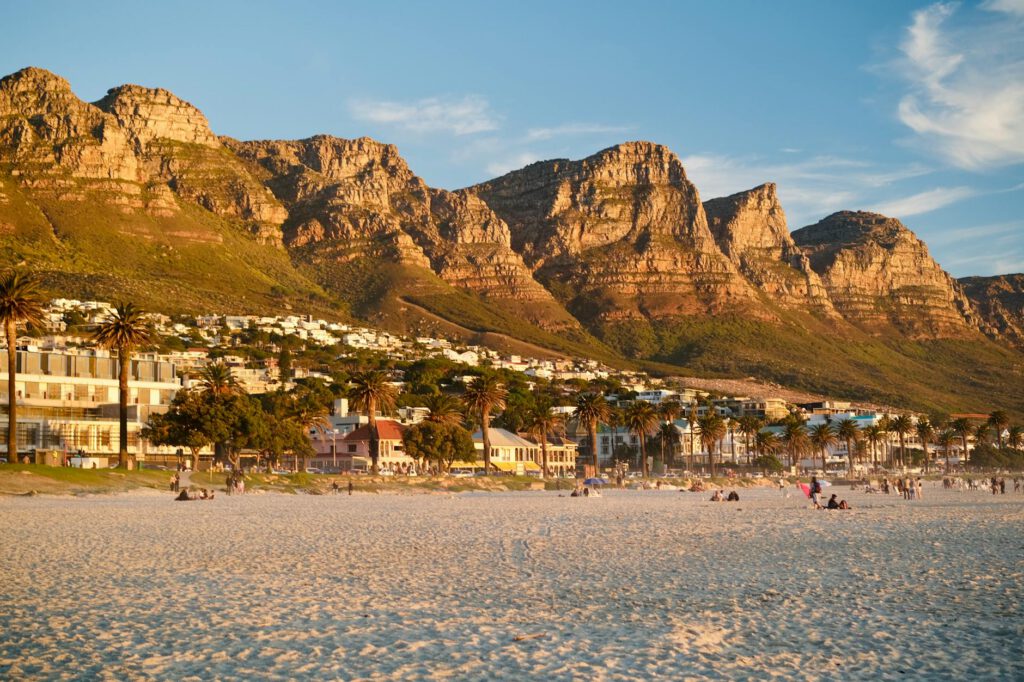
Camps Bay and Clifton are the Atlantic Seaboard’s glamour postcodes. White sand, turquoise water, the Twelve Apostles mountain range dropping straight into the sea. You already know this from Instagram. What you might not know is that as a digital nomad base, these two neighbourhoods are expensive, inconvenient, and probably wrong for you. They’re still worth understanding, because some people have the budget and priorities that make them work. Most don’t.
The vibe
Camps Bay is a single palm-lined strip of restaurants and bars facing one of the most photographed beaches in Africa. During summer (November through March), the sunset scene draws locals and tourists in roughly equal measure. Champagne gets popped. DJs play. It feels like a Mediterranean resort town that happens to be in South Africa.
Clifton sits just around the corner toward the city, with four numbered beaches tucked into granite coves. It’s quieter, more residential, and even more expensive. Where Camps Bay has a tourist energy, Clifton has old-money energy. Think R40 million houses behind security gates, accessed by steep staircases. Not a coffee shop in sight.
Both neighbourhoods share a backdrop: the Twelve Apostles mountain range, Chapman’s Peak in the distance, and the kind of light that makes everything look like a film set. It’s genuinely beautiful. That’s not the issue. The issue is whether beautiful is enough when you need to get work done.
Outside of peak season, Camps Bay goes quiet. Many restaurants close or cut hours. The strip empties. If you arrive in June expecting the sunset scene, you’ll find rain, wind, and closed shutters.
Internet and connectivity
Fibre coverage in Camps Bay is reasonable. Most apartment blocks and newer developments along Victoria Road and the main strip have Vumatel or Octotel connections, with speeds up to 500 Mbps available through ISPs like Atomic, Cool Ideas, or Afrihost.
Clifton is more hit-and-miss. Many properties are older houses on steep hillsides, and not all have been connected to fibre networks. Some still rely on fixed-LTE or mobile data. If you’re considering Clifton, check your exact address on Vumatel’s coverage checker before signing anything. Don’t assume.
In both areas, load shedding can be a factor. Newer apartment complexes often have inverter or generator backup, but standalone houses may not. Ask before you book.
Coworking and work spots
This is where Camps Bay falls flat for remote workers. There are essentially no coworking spaces. Zero. Nothing.
Your options are:
- Work from home. If your accommodation has decent fibre and a proper desk setup, this is your default.
- Cafe sitting. Camps Bay has a handful of restaurants with WiFi, but they’re geared toward tourists having lunch, not someone parking a laptop for four hours. Expect pressure to order and move on.
- Drive to Sea Point or the CBD. Workshop17 at the V&A Waterfront is about 15 minutes by car. Neighbourgood in De Waterkant, 20 minutes. The CBD’s coworking cluster is the same distance.
If coworking matters to your routine, Camps Bay adds a commute to your day that you wouldn’t have in Green Point, Sea Point, or the City Bowl. That commute is also on a single road, which brings us to the next problem.
Accommodation
Camps Bay accommodation is expensive by Cape Town standards and wildly expensive by South African standards.
Expect to pay:
- Furnished 1-bedroom apartment: R18,000–R30,000/month during shoulder season (April–October)
- Same apartment in peak season (December–February): R28,000–R45,000/month or more
- Clifton 1-bedroom: R25,000–R40,000/month, sometimes higher, with far less availability
- Airbnb/short-term rental (Camps Bay): R1,200–R3,500/night in summer; R600–R1,500/night in winter
Seasonal pricing is aggressive. Many landlords and property managers switch to nightly Airbnb rates from mid-November through mid-February, which means monthly tenants get squeezed out or face sharp price hikes. If you want a summer lease, negotiate early—by September at the latest.
Most rentals are furnished and include WiFi. Secure parking is common but not guaranteed in older buildings. Properties on the mountain side of Victoria Road tend to be slightly cheaper than beachfront, and some have better views anyway.
For listings, check Property24, Airbnb, and local agencies like Camps Bay Property and Atlantic Lets. Clifton rentals are harder to find online—many move through word of mouth or exclusive agencies.
Getting around
Camps Bay and Clifton share one critical infrastructure problem: there’s essentially one road in and out. Victoria Road connects both areas to Sea Point and the CBD to the north. Kloof Nek Road goes over the saddle to the City Bowl. That’s it.
During morning and evening rush, Victoria Road backs up. A drive that takes 10 minutes at noon takes 25–35 minutes at 8 AM. On summer weekends, when half of Cape Town heads to Camps Bay beach, the traffic can be worse.
There is a MyCiTi bus service along the route, which helps. The 108 and 109 routes connect Camps Bay to the CBD via Sea Point. But frequency is limited, and in the evenings it thins out considerably.
Uber and Bolt work fine but expect surge pricing on summer evenings and after events. Budget R80–R120 for a one-way trip to the CBD during normal hours.
Parking in Camps Bay itself is a nightmare in season. Beach parking fills by 10 AM on sunny days, and side streets fill right after. If your accommodation doesn’t include a bay, this becomes a daily irritation.
One road. One route. That’s the fundamental constraint. If you need to be somewhere at a specific time, leave a buffer.
Food and essentials
The Camps Bay strip has around 20 restaurants, mostly mid-range to upmarket. Codfather (seafood and sushi), The Hussar Grill (steaks), Cafe Caprice (cocktails and people-watching), Chinchilla (rooftop bar). Meals run R180–R350 per person for mains, with drinks pushing a dinner for two past R800 easily. These are tourist-area prices, and the food quality is uneven. Some places coast on the view.
For groceries, there’s one Spar on the main road. It covers basics—bread, milk, meat, some produce—but selection is limited and prices are higher than a Checkers or Pick n Pay in the suburbs. For a proper grocery run, you’ll likely drive to the Sea Point Checkers or Woolworths, about 10 minutes away.
Clifton has no shops. None. No restaurants, no cafes, no grocery stores. If you’re based in Clifton, you drive to Camps Bay for coffee or Sea Point for groceries. Every single time.
There’s no Takealot pickup point nearby. Deliveries work but take longer than in the CBD. Mr D Food and Uber Eats cover Camps Bay but rider availability drops after 9 PM and in bad weather.
Safety
Camps Bay and Clifton are among the safer areas in Cape Town. Violent crime is low. You can walk along the beachfront strip during the day and early evening without significant concern.
That said:
- Car break-ins along Victoria Road and at beach parking areas are a known issue. Don’t leave anything visible in your car. Nothing. Not a cable, not a bag, not a jacket.
- Petty theft on the beach happens, especially in busy summer months. Don’t leave valuables unattended on your towel while swimming.
- Late at night, the strip empties and gets quiet. Walking home from a restaurant at 11 PM is generally fine, but walking along dark stretches of Victoria Road alone is best avoided.
- Clifton’s steep stairways are poorly lit at night. Use your phone torch and stick to main access points.
Overall, safety is not a primary concern here compared to many other Cape Town neighbourhoods. It’s one of the few genuine advantages of the area.
Beach life
This is where Camps Bay and Clifton earn their reputation. The beaches are exceptional.
Camps Bay Beach is the main event: a wide, white-sand stretch backed by the restaurant strip and framed by the Twelve Apostles and Lion’s Head. Water temperature is cold—13–17°C year-round (this is the Atlantic, not the Indian Ocean). The beach has lifeguards in summer, and the sand is generally clean. Sunset here is the real draw.
Clifton 1st Beach is the most social, popular with younger crowds and sometimes used for beach volleyball. 2nd Beach is the family beach. 3rd Beach is quieter, popular with the gay community. 4th Beach is the biggest and most popular overall, with good facilities and lifeguards in season.
All four Clifton beaches are sheltered from the south-easter wind by the granite boulders, which makes them usable even when Camps Bay is being sandblasted. This is important—on a windy summer day, Clifton is beach-functional while Camps Bay is not.
Glen Beach (between Camps Bay and Clifton) is a smaller cove popular with bodyboarders and surfers. Beta Beach (below Bakoven, just past Camps Bay heading south) is a secluded spot with big boulders and calm water.
If beach access is your top priority and you can afford the rent, this is genuinely the best stretch of coast in Cape Town for day-to-day swimming and sunbathing.
The trade-offs
Every neighbourhood guide should be honest about what doesn’t work. Camps Bay and Clifton have a longer list than most.
Wind. The south-easter hits Camps Bay harder than almost anywhere else in the city from October through March. We’re talking 40–60 km/h gusts that make outdoor dining miserable and beach time unpleasant. Clifton’s coves offer some shelter, but the wind remains a defining feature of summer here. Locals call it the Cape Doctor. Nomads call it the reason they moved to Sea Point.
Cost. You’re paying a premium of 30–60% over comparable accommodation in Green Point or Sea Point, with fewer amenities, no coworking, and limited shopping. That premium buys you a beach view and proximity to sand. Decide if that’s worth R8,000–R15,000 extra per month.
One road. Already covered, but worth repeating. Victoria Road is your lifeline, and it’s a bottleneck. Accidents, road works, or a busy beach day can cut you off.
Tourist crowds. December through February, Camps Bay is overrun. The strip is packed, parking is impossible, and the atmosphere shifts from neighbourhood to resort. If you’re working, this is noise and friction, not ambiance.
Limited services. No coworking. One small supermarket. No gym of note (the nearest Virgin Active is in Sea Point). Few services that cater to residents rather than visitors.
Isolation. Camps Bay can feel disconnected from the rest of Cape Town. If your social life or professional network is in the CBD, Woodstock, or the Southern Suburbs, you’ll spend a lot of time in the car.
Who should (and shouldn’t) pick Camps Bay or Clifton
Consider it if you:
– Have a monthly accommodation budget above R25,000 and don’t flinch at seasonal pricing
– Work primarily from home and your apartment has solid fibre
– Prioritize beach access and natural beauty above all else
– Don’t need coworking or walk-to-everything convenience
– Are staying short-term (a few weeks) and want the Cape Town postcard experience
– Have a car or don’t mind regular Uber costs
Skip it if you:
– Are budget-conscious (under R18,000/month for rent)
– Need coworking spaces as part of your daily routine
– Rely on public transport
– Want a neighbourhood with cafes, gyms, and shops within walking distance
– Are coming in winter and expect the summer atmosphere
– Prefer a working neighbourhood over a holiday neighbourhood
For most digital nomads, Green Point, Sea Point, or the City Bowl offer better value and a more practical daily setup. Camps Bay is where you go for sundowners on Friday, not where you base yourself for three months of deep work.
Quick reference
| Category | Details |
|---|---|
| Monthly rent (1-bed furnished) | R18,000–R35,000+ (seasonal) |
| Fibre availability | Good in Camps Bay; patchy in Clifton |
| Fibre providers | Vumatel, Octotel |
| Coworking | None — drive to Sea Point or CBD |
| Nearest coworking | Workshop17 V&A Waterfront (15 min drive) |
| Grocery | Spar Camps Bay (limited); Checkers Sea Point (10 min drive) |
| Public transport | MyCiTi 108/109 to CBD via Sea Point |
| Safety | Low crime; car break-ins at beach parking |
| Beach water temp | 13–17°C (Atlantic) |
| Wind exposure | High (Oct–Mar south-easter) |
| Best for | Short-term stays, beach lovers, high budgets |
| Walk score | Low — car or Uber needed for most errands |
| Drive to CBD | 10–25 min depending on traffic |
| Drive to airport | 25–40 min |
Tools we trust
Partners we use and recommend, tested in Cape Town.
We may earn a commission on purchases made through these links, at no extra cost to you. We only recommend products and services we actually use.