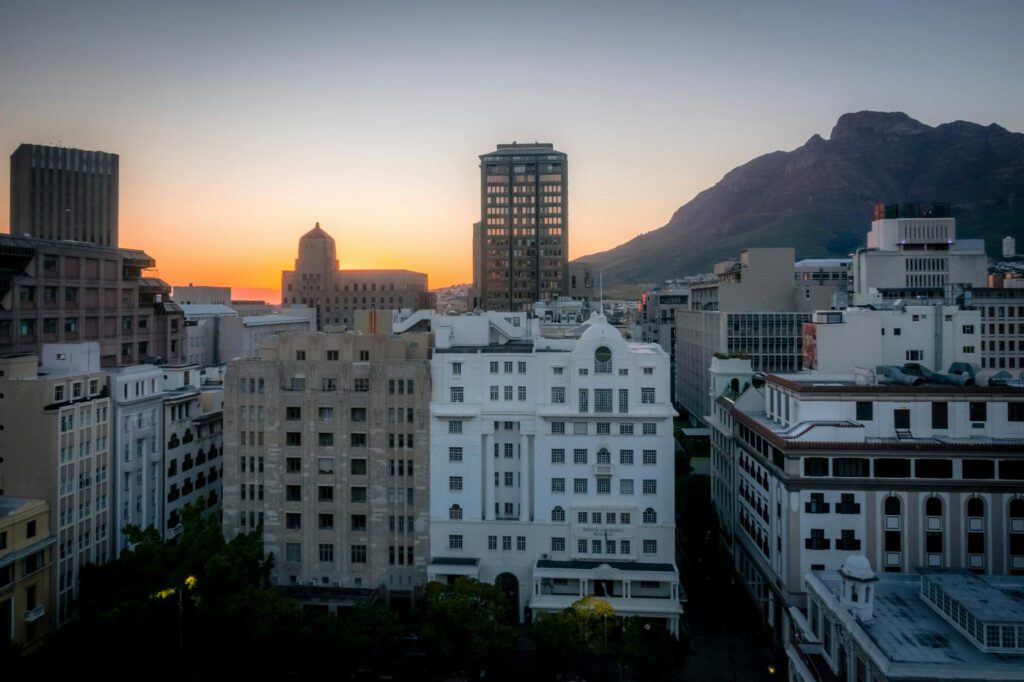
Cape Town’s CBD is where the money moves. Government buildings, corporate towers, law firms, and fintech startups all stack up in a tight grid between the harbour and the foot of Table Mountain. Gardens starts where the concrete thins out — tree-lined streets climbing uphill toward the mountain, Victorian-era houses converted into flats, and a pace that slows noticeably as you walk south from Wale Street. For nomad purposes, these two areas overlap enough to treat as one. You’ll likely work in the CBD and live in Gardens, or split your time between a coworking desk downtown and a cafe on Kloof Street.
The vibe
The CBD is a proper city centre. During business hours it hums — suits, Ubers, construction, the Grand Parade markets on weekdays. Long Street runs through the middle of it like a spine, and depending on the block you’re on, it’s either backpacker bars or vintage shops or both. Bree Street has quietly become the more polished sibling: wine bars, small-plate restaurants, independent boutiques. If Long Street is the friend who stays out until 3am, Bree Street is the one who suggests a natural wine and an early night.
Gardens feels different. Kloof Street is the anchor — a steep road lined with restaurants, coffee shops, and small retailers. Walk further uphill and you’re in proper residential territory. Old apartment buildings with parquet floors, garden flats with mountain views, and a quiet that surprises people who assumed the whole City Bowl was loud. Company’s Garden — the old VOC garden, now a public park — sits between the two areas and gives you a green corridor to walk through on your way downtown.
You get the infrastructure of a city centre paired with a residential neighbourhood that feels like somewhere people actually live.
Internet and connectivity
The CBD has some of the best fibre coverage in Cape Town. Vumatel, Openserve, and Octotel all have infrastructure here, and most commercial buildings are already connected. If you’re in a modern apartment block or a serviced office, you’ll typically have access to symmetrical fibre up to 1 Gbps. Even older buildings have been retrofitted — the demand from businesses in the area made that inevitable.
Gardens coverage is strong but worth checking at the address level. Vumatel is the dominant FNO, with Octotel also present in parts. Most furnished apartments advertise uncapped fibre between 50 Mbps and 200 Mbps. Before signing a lease, verify coverage on Vumatel’s coverage checker and Octotel’s map. Some of the older heritage buildings on the upper slopes can have patchy last-mile connections.
Mobile data backup is solid throughout. Vodacom and MTN both have strong 4G/5G signal in the CBD, and Rain 5G covers much of the City Bowl if you want a fixed wireless backup line.
Coworking and work spots
This is where CBD and Gardens genuinely shine. The density of coworking options here is unmatched in Cape Town.
Workshop17 at the Watershed (V&A Waterfront edge) and their Kloof Street location give you two distinct environments — harbour-adjacent or mountain-facing. Hot desks start around R2,500/month, dedicated desks from R4,500. The Kloof Street space is particularly good for nomads: smaller, quieter, and you’re already in Gardens for after-work.
WeWork on Strand Street occupies several floors of a converted heritage building. Hot desks from around R3,000/month. The main advantage is the global network: if you’re already a WeWork member from Berlin or Bali, your membership works here.
Ideas Cartel operates out of a beautiful old building on Shortmarket Street. More creative energy than WeWork, less corporate than Regus. They do hot desks, private offices, and event space. Monthly membership runs from R2,500 for flex access.
Spaces (IWG group) has locations on Long Street and Buitengracht. Solid, reliable, slightly more corporate. Good meeting rooms if you need to impress a client on a video call.
Neighbourgood on Bree Street leans creative and community-oriented. Regular events, a rooftop bar, and a more social atmosphere than the corporate options.
Beyond dedicated coworking, the cafe culture means you’re never short of places to work. Truth Coffee Roasting, Haas Coffee, Rosetta Roastery on Bree Street, and Kloof Street House all tolerate laptop workers during off-peak hours. Buy something every couple of hours and don’t hog a four-top during lunch.
Accommodation
CBD apartments skew modern, compact, and functional. Furnished one-bedroom units run R10,000 to R16,000 per month. At the lower end you’re getting a studio or small one-bed in an older conversion; at the top end, a newer build with gym, pool, and secure parking. Buildings like The Rockwell, 16 on Bree, and various Rawson developments are worth looking at.
Gardens runs slightly higher: R12,000 to R18,000 for a furnished one-bedroom. The premium buys you quieter streets, more space, and often a view of Table Mountain or the city lights. Kloof Street-adjacent apartments go faster and cost more. The further uphill toward Oranjezicht, the more peaceful — but also the steeper your walk home.
Airbnb is competitive in both areas, with monthly-stay discounts bringing some listings into the R14,000-R20,000 range. For longer stays (three months plus), negotiate directly with landlords on Property24 or Private Property — you’ll typically save 10-15% over advertised rates.
One thing to watch: if you’re on Long Street or Bree Street above a restaurant, weekends will be loud. Ask about noise specifically before committing.
Getting around
The CBD is the MyCiTi bus network’s central hub. The Civic Centre station connects to routes running to Sea Point, Green Point, the V&A Waterfront, Table View, and the airport. If you don’t have a car and plan to use public transport, there is no better base in Cape Town. A myconnect card loaded with stored value keeps fares low — most trips within the city run R10-R20.
Walking is the default within the CBD and Gardens. From the top of Kloof Street to the bottom of Adderley Street is about a 20-minute walk downhill (longer coming back — the gradient is real).
Uber and Bolt are everywhere. Short trips within the City Bowl run R30-R60. The Waterfront is R40-R60. The airport is R150-R250 depending on traffic. Surge pricing kicks in on Long Street after midnight on weekends, but that’s avoidable.
If you have a car, parking is the main frustration. Street parking in the CBD is metered and contested during business hours. Secure monthly parking runs R800-R1,500. Gardens has more street parking, but finding a spot on Kloof Street after 6pm requires patience.
Food and essentials
Kloof Street is one of Cape Town’s best restaurant strips. Kloof Street House (local favourite, reliable menu, garden setting), Chefs Warehouse (tapas-style, book ahead), and the collection of smaller spots running uphill give you serious variety without needing a car. Budget R120-R250 per person for a sit-down dinner.
Bree Street is the other food corridor. La Tête (nose-to-tail, excellent), Culture Club Cheese (toasties and cheese boards), Tiger’s Milk (pub food, big portions), and Jason Bakery (pastries and sandwiches). The density means you can eat somewhere different every night for a month.
For groceries, Woolworths on Kloof Street and Checkers on Long Street cover daily needs. Pick n Pay on Waterkant Street is the closest full-size supermarket for the CBD. If you cook regularly, the Neighbourgoods Market at the Old Biscuit Mill (Woodstock, Saturday mornings) is a 10-minute Uber for fresh produce and bread.
Dischem pharmacy on Long Street, banks and ATMs throughout the CBD, Gardens Centre for anything else.
Safety
This is the section that matters most, and honesty matters more than comfort here.
The CBD after business hours is a real concern. Once the offices empty out around 6pm, large sections of the downtown grid become quiet in a way that doesn’t feel safe. The blocks around the Grand Parade, the station precinct, and parts of lower Long Street see higher rates of mugging and opportunistic theft after dark. This isn’t speculation — it’s consistent across years of crime data and local experience.
Specific guidance: Adderley Street below Wale is fine during the day but avoid walking alone after dark. The area around Cape Town Station and the taxi rank is consistently the highest-risk zone. Long Street between Wale and Strand is active at night but the lower end toward the harbour gets empty. Bree Street is safer in the evening — restaurants keep foot traffic going until 10-11pm.
Gardens is significantly safer. Kloof Street is well-lit and busy until late. The residential streets above Kloof are quiet and generally low-risk, though standard precautions apply. The CCID (Central City Improvement District) patrols both areas with visible security and good response times.
Practical steps: use Uber after dark rather than walking through quiet CBD blocks. Stay on the main restaurant streets where there’s foot traffic. Don’t flash expensive gear. If you’re living in the CBD, choose a building with 24-hour security and access control.
Nightlife and culture
Long Street is the classic Cape Town night out. Backpacker bars, live music venues, clubs, and late-night food spots packed together on a single street. It’s messy, loud, and fun if that’s what you want. The Waiting Room (rooftop bar), Fiction (DJ sets), and Mama Africa (live marimba, tourist-heavy but genuinely good atmosphere) are the stalwarts.
Bree Street is the grown-up alternative. Publik Wine Bar, House of Machines (motorcycles, cocktails, live music), and Orphanage Cocktail Emporium draw a crowd that’s more local, more design-conscious, and less likely to end the night on a sidewalk.
Beyond nightlife: the Zeitz MOCAA is at the Waterfront edge, the Iziko National Gallery sits in Company’s Garden, and the Fugard Theatre hosts regular productions. The First Thursdays art walk (first Thursday of every month) opens galleries across the CBD and Woodstock for free evening viewings — one of the best free cultural events in the city.
If you’re a creative or cultural nomad, no other area in Cape Town concentrates this much arts access.
The trade-offs
The CBD empties. This is the biggest one. Between 6pm and 7am on weekdays, and most of the weekend, large parts of downtown feel deserted. The streets that buzz at noon become the streets you Uber through at 9pm.
Noise is directional. Live on Long Street or lower Bree and you’ll hear music, shouting, and bottle-clinking until 2am on weekends. Live on upper Kloof or the residential streets of Gardens and you might hear nothing but hadedas at 5am. Choose your specific address carefully.
Parking is a daily frustration if you have a car. The CBD was not designed for the number of vehicles it handles, and Gardens’ narrow streets fill up quickly.
Summer southeasters funnel through the buildings and can make outdoor cafe work unpleasant from November to March. The mountain blocks some of it in Gardens, but not all.
Homelessness is visible in the CBD, particularly around Company’s Garden and on Wale Street. This is a reality of South African cities you’ll encounter daily.
Who should pick CBD and Gardens
Choose CBD and Gardens if you:
– Want the highest density of coworking spaces in Cape Town
– Thrive on urban energy during the day and don’t mind quieter evenings
– Prioritise public transport access — MyCiTi is best from here
– Care about food, culture, nightlife, and walkable access to all three
– Want reliable fibre with multiple FNO options
– Prefer spending R10,000-R18,000 on rent rather than R25,000+ in Sea Point
Skip CBD and Gardens if you:
– Need your neighbourhood to feel safe and active after 9pm every night
– Want a beachfront lifestyle — the ocean is a bus ride away
– Are noise-sensitive and don’t want to research your exact building carefully
– Prefer a tight-knit nomad community — Sea Point and Green Point have more of that
– Drive daily and don’t want parking to be a constant negotiation
For most nomads, Gardens is the better half for living. The CBD is where you work, eat, and go out. Find a Gardens apartment within walking distance of Kloof Street and a coworking space downtown, and you’ve got one of the best setups in Cape Town for the price.
Quick reference
| Category | CBD | Gardens |
|---|---|---|
| Rent (furnished 1-bed) | R10,000 – R16,000/month | R12,000 – R18,000/month |
| Internet | Vumatel, Openserve, Octotel; up to 1 Gbps | Vumatel, Octotel; 50-200 Mbps typical |
| Coworking | WeWork, Ideas Cartel, Spaces, Neighbourgood | Workshop17 Kloof, cafe options |
| Transport | MyCiTi hub, fully walkable | Walkable (hilly), MyCiTi nearby |
| Safety (evening) | Caution required after 6pm | Generally safe, standard awareness |
| Noise | High on Long/Bree St weekends | Low-moderate, Kloof St can carry sound |
| Grocery | Checkers, Pick n Pay | Woolworths Kloof, Gardens Centre |
| Best for | Working, eating out, nightlife | Living, quiet work, cafe culture |
Related: Compare all Cape Town neighbourhoods for digital nomads | Coworking options beyond the CBD | Cape Town safety guide
Tools we trust
Partners we use and recommend, tested in Cape Town.
We may earn a commission on purchases made through these links, at no extra cost to you. We only recommend products and services we actually use.