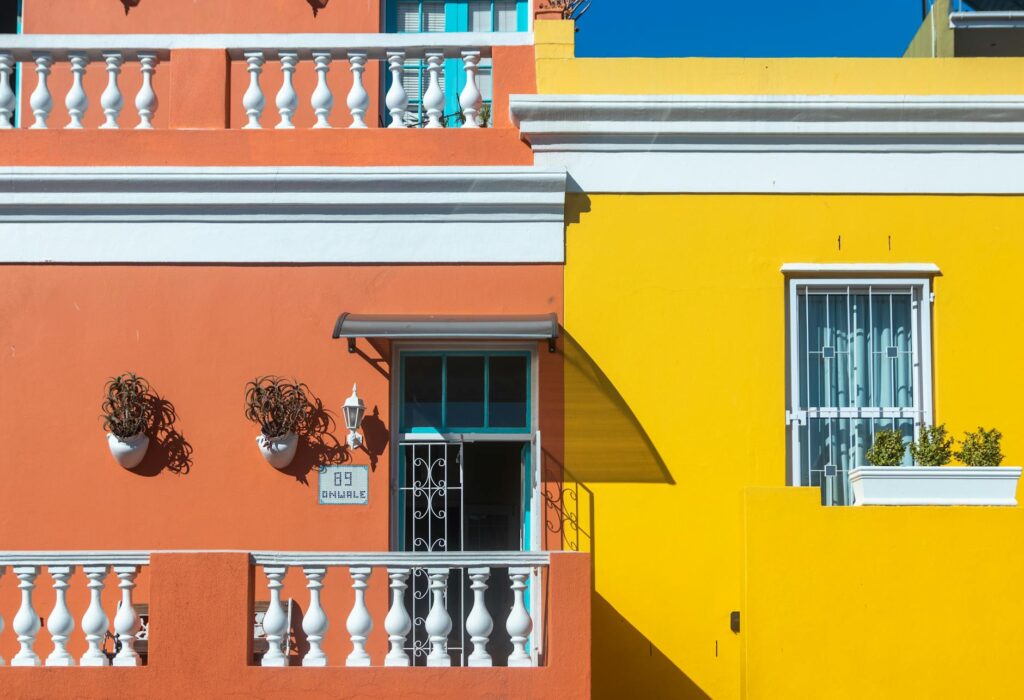
Bo-Kaap is the neighbourhood most visitors have already seen before they arrive. The painted facades on Chiappini Street have been on every Cape Town mood board for the last ten years, and on a February afternoon you will find tour groups lined up along the pavements taking the same three photos their guidebooks told them to take. It is easy, from the outside, to read the whole area as a photo set.
It is not. Bo-Kaap is a working residential neighbourhood that has been one for more than two centuries, and the families who live behind those facades are the same families who have lived behind them for generations. Pull one block up the hill from the tourist stretch, turn onto Upper Leeuwen or onto Pentz, and the atmosphere changes immediately. Kids on bikes. Uncles on stoeps. Washing lines. A mosque bell you can set your day to.
For a digital nomad weighing Bo-Kaap as a base, this is the key read: you are not moving into a lifestyle district, you are moving into somebody’s long-standing home. That is exactly what makes it interesting, and it is also exactly what makes it demanding. This guide is the resident take on what that trade-off actually looks like over a month.
We have written this one carefully on purpose. The community here has had a long, uneven relationship with tourism and property speculation, and we would rather lose a booking than hand you a script that helps nobody.
The history that matters
Bo-Kaap grew from the slave and artisan quarters of the late 18th and 19th centuries, and the community took its present shape after emancipation in 1834, when freed Muslims from across the Indian Ocean world settled on the slopes below Signal Hill. The area is the historic heart of the Cape Malay community, and Afrikaans and Cape Malay Afrikaans are the languages you will still overhear on the streets. Gatam, which you will see on some signage and menus, is the local name for the neighbourhood itself.
The mosque density here is not incidental. Auwal Masjid on Dorp Street, founded in 1794, is the oldest mosque in South Africa, and there are half a dozen active mosques inside a few blocks. In 2018 and 2019, residents mobilised against a wave of developer pressure and high-rise rezonings, and the protests eventually contributed to Bo-Kaap being declared a heritage protection area. Knowing that story changes how you walk the streets.
Where Bo-Kaap sits
Bo-Kaap climbs the lower slope of Signal Hill, directly above the Cape Town CBD. Wale Street is the main axis, running up from the edge of the Company’s Garden and CBD and Gardens into the residential core. The most-photographed blocks are Chiappini Street and the lower stretches of Leeuwen, Rose and Pentz. The western edge of the neighbourhood bleeds into De Waterkant, which is a very different place: polished, commercial, design-led, mostly short-let apartments.
The distinction matters. A “Bo-Kaap” Airbnb on the De Waterkant side will feel nothing like one on Upper Chiappini. One is a serviced apartment in a design precinct. The other is a cottage three doors down from a family that has been there for forty years.
The respectful-stay framing
We will be direct. Bo-Kaap is not a theme park and it is not a set. If you take one thing from this guide, take this: photographing a facade from the street is fine. Photographing a doorway while somebody is standing in it is not. Photographing children is not. Climbing onto someone’s stoep to get the angle is not. Posing in front of a front door as if it is a backdrop is, at best, thoughtless.
The call to prayer runs five times a day from multiple mosques, and the first is before dawn. During Ramadan the rhythm of the neighbourhood shifts: quieter days, late communal meals, a different energy after sunset. None of this is a problem to be managed, but if you sleep light and you need silence from 4am onwards, a flat within earshot of a minaret is not your flat.
Good month-long behaviour here looks like the same good behaviour you would want from a visitor to your own street. Greet your neighbours. Keep noise down after 10pm. Do not host loud events in a short-let cottage. Buy your bread and spices from the shops on the corner instead of importing everything from Woolworths. Read the room during Ramadan and Eid. The community is warm when you show up as a neighbour and cold, reasonably, when you show up as a content creator.
Daily rhythm
A typical Bo-Kaap day for a nomad looks like this. Coffee on Wale Street or a short walk down to Bree. A work session at a cafe or back at the flat. Lunch at one of the Cape Malay kitchens. An afternoon walk down into the CBD for errands, the Company’s Garden, or a meeting. Sunset back up the hill, which is short and steep enough to count as exercise. Dinner at home or out in the CBD. The geography naturally pushes you into a slower, more walkable pattern than a car-dependent suburb would.
Cafes, food and Cape Malay cuisine
The food is the reason many residents quietly consider Bo-Kaap the best-eating corner of central Cape Town. Biesmiellah on the corner of Wale and Pentz is the institution, a halal family restaurant serving bobotie, denningvleis, tomato bredie and samoosas that have been on the same menu for decades. Bo-Kaap Kombuis, higher up the hill, is the sit-down view option with a traditional Cape Malay menu and one of the better sundowner panoramas in the city. Atlas Trading on Wale Street is a spice shop, not a cafe, and it is where half of Cape Town buys its masala, rose water and dried chilli. Walk in, ask for what you need, pay cash.
For day-to-day coffee, the Wale Street and lower Bree Street cafes cover most of what a remote worker needs. For a wider pull-back on the city, see our Cape Town specialty coffee guide and our round-up of Cape Town food markets, most of which are a walkable distance away.
Worth knowing: many of the Cape Malay kitchens are not licensed for alcohol and a good number are halal. If that shapes your evenings, shape them accordingly.
Rent reality
Bo-Kaap pricing has been pulled upward by short-let demand and the heritage premium, and 2026 numbers reflect that. For a monthly stay booked direct or through a medium-term platform, expect:
- Period cottage, 1 bedroom, basic finish: R15,000 to R22,000 per month
- Restored 1-bedroom cottage or apartment: R18,000 to R30,000 per month
- 2-bedroom restored cottage: R25,000 to R40,000 per month
Nightly Airbnb rates are meaningfully higher per night than an equivalent flat in Tamboerskloof or Oranjezicht, and the short-let supply is concentrated on the photogenic blocks, which are also the noisiest. If budget matters, ask about views, street, and distance from the nearest mosque before booking. For the wider picture see our cost of living in Cape Town 2026 guide and our notes on short-term accommodation in Cape Town.
Walkability
Walkability is the quiet superpower here. You can be at Greenmarket Square in ten minutes, at Company’s Garden in twelve, and at the lower cable car station at Kloof Nek in a brisk twenty-five. Lion’s Head at sunrise is an Uber away, and the lower contour paths of Table Mountain start within walking distance. For the beaches, the southern suburbs, Woodstock or the winelands, you are back to an Uber or a rental car.
Safety
Bo-Kaap generally feels safer than the CBD core at night, largely because of the strong residential presence. People know each other, stoeps are occupied, the streets are rarely empty. The honest caveats are the ones that apply to any tourist-adjacent block in central Cape Town: petty theft does happen on the photo-tour stretches, phones get snatched when distracted tourists hold them out over the road, and bag discipline in restaurants matters. Walking alone late at night on the quieter upper streets is lower risk than the same walk through the CBD, but still a walk worth doing with a friend. Our full Cape Town safety guide and our honest read on the hard parts cover the rest.
Who Bo-Kaap works for
Bo-Kaap is a good base for nomads who want a month of real cultural texture, a walkable life into the CBD, and a willingness to be a neighbour instead of a visitor. It works for writers, researchers, longer-stay remote workers who want a slower morning and a proper dinner culture, and people who travel to learn places rather than to collect them. A First Thursday art crawl starts on your doorstep, and our First Thursdays guide will point you at the route.
It is not the base for nomads who want a secular remote-work bubble, a pool, or a beach. It is not the base for anyone whose idea of a city break is open bars until 3am. And it is actively the wrong base for anyone who is only coming for the photos. There are better options in Sea Point, Tamboerskloof, or Oranjezicht.
Related guides
- CBD and Gardens neighbourhood guide
- Cape Town safety guide
- Honest about the hard parts of Cape Town
- Short-term accommodation in Cape Town
- Cost of living in Cape Town 2026
- Cape Town specialty coffee
- Cape Town food markets
- First Thursdays in Cape Town
- Lion’s Head sunrise hike
- Table Mountain hiking guide
Tools we trust
Partners we use and recommend, tested in Cape Town.
We may earn a commission on purchases made through these links, at no extra cost to you. We only recommend products and services we actually use.