The mountain teaches you fast. You arrive at the Platteklip Gorge trailhead on a clear morning, feeling strong. The city gleams below, and the sky is blue. By the time you’re halfway up the constant stone steps, the wind has picked up, your water is halfway gone, and you understand why Table Mountain is both the most accessible and most humbling peak in Cape Town.
Hiking Table Mountain is a genuine experience, not an Instagram location. The routes are real, the weather is unforgiving, and the mistakes hikers make — under-hydration, wrong shoes, arriving at 10 AM in summer — repeat so predictably that search and rescue on the mountain logged over 100 callouts in just the first half of 2023. Most had nothing to do with technical difficulty. They had everything to do with being unprepared.
This guide tells you what works, what doesn’t, and why. We’ve pulled in the data on rescue incidents, trail conditions, and what actually happens on the mountain — not the postcard version.
Platteklip Gorge: the go-to route for first-timers
Start here. Not because it’s the easiest — it’s steep and relentless — but because it’s the most direct, the most logical, and it teaches you what Table Mountain is actually like.
Platteklip Gorge covers 2 km from the trailhead on Tafelberg Road to the upper cable station, with 650 metres of elevation gain. You’ll climb in 1 to 1.5 hours if you’re reasonably fit. The descent takes 30 to 45 minutes, so the full round trip runs 3 to 3.5 hours. The route is a steep, logical staircase of rock steps with no scrambling or exposure to drops — it’s punishing on the quads and lungs, but never technical.
Why Platteklip?
It’s the quickest way to the top. There’s no navigation confusion (the route is obvious). And crucially, it gets you off the mountain earlier in the day, before the Southeaster wind picks up and afternoon clouds roll in. If you leave by 6 or 7 AM, you’ll be down by late morning when the mountain is still in your favour.
The data backs this: Platteklip sees more rescue callouts than any other Table Mountain route, but nearly all are for heat stress, fatigue, and dehydration on the walk up — not technical falls or navigational disasters. Early start, enough water, and realistic fitness assessment solve almost all of these.
Parking is available along Tafelberg Road, past the cable car station. Arrive by 7 AM in summer to secure a spot; the lot fills quickly by 8 AM.
Other main routes
If you want alternatives or more of a day in the mountains, these are the solid options.
Skeleton Gorge and Nursery Ravine: These routes start from Kirstenbosch Gardens on the Newlands side of the mountain. Skeleton Gorge is a strenuous 5 km climb through forest and fynbos, climbing 650 metres to the top. Nursery Ravine is a slightly easier descent route, so a common pairing is to ascend Skeleton and descend Nursery (or vice versa). This makes for a 10 km loop, a proper day’s hike, and the forest canopy offers shade that Platteklip lacks entirely. Both are steep and solid.
India Venster: This is the most technical route on Table Mountain’s northern face. It involves more scrambling and some exposure, so it’s for hikers with decent rock experience. It’s steeper and more engaging than Platteklip, but also requires better footwork and navigation. Not a first-timer route.
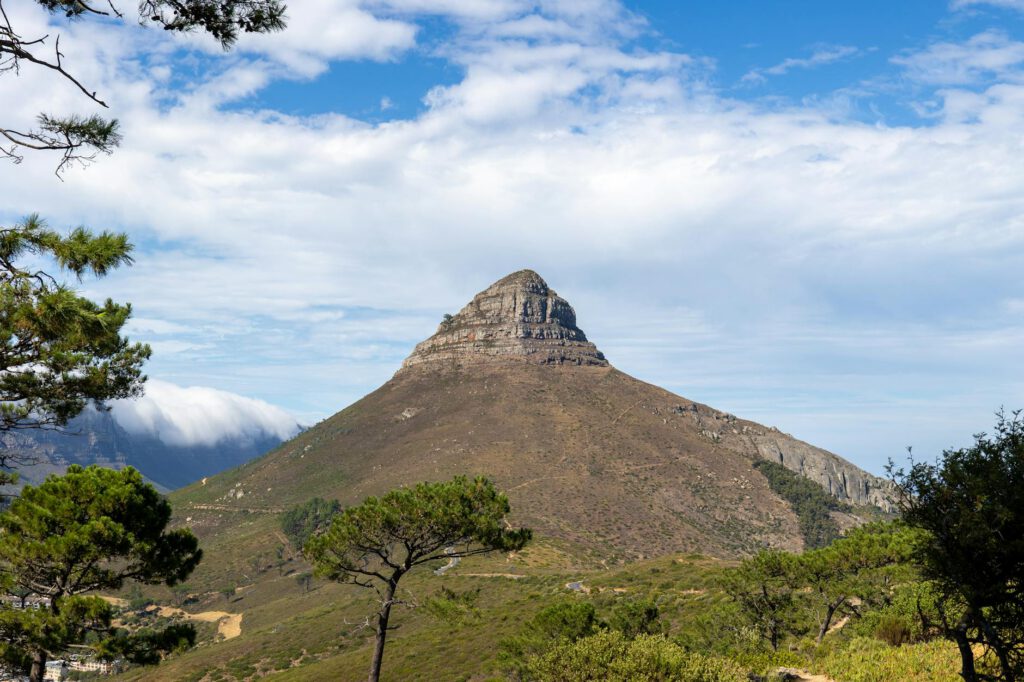
Lion’s Head: This isn’t Table Mountain, but many hikers consider it next. Lion’s Head is lower (669 metres), shorter (2 km to the summit, 1 hour up), and more exposed in terms of drops and wind. It’s a good stepping stone before Table Mountain, or a standalone summit. We’ve covered it separately — see the Lion’s Head sunrise guide.
When to hike: timing matters more than you think
Table Mountain’s weather is hostile in summer. December through February, the Southeaster — locals call it the Cape Doctor — whips across the mountain with gusts that exceed 60 km/h on the summit. Heat on exposed rock like Platteklip can be 10 degrees hotter than the air temperature. Dehydration compounds quickly.
Best months: November and March offer the sweet spot — mild weather, lower wind, fewer crowds. September and October showcase the fynbos in full flower (60% in bloom in spring). Autumn (April-May) is equally good, with less rain than winter approaches.
Best time of day: Start before 7 AM in summer. The Southeaster typically rises in late morning and becomes ferocious by afternoon. Early starts also beat congestion and get you down before the day heats up. If you’re hiking Skeleton Gorge or Nursery Ravine in the Kirstenbosch area, starting at dawn is even more important — the forest provides less exposure, but afternoon mist and wind are real concerns.
Avoid: January and February. Peak summer crowds combine with peak wind and heat. If you must hike in summer, do Platteklip before 8 AM and accept that the summit may be windy and clouded.
What to bring (non-negotiable)
Platteklip and Skeleton Gorge hikers report dehydration as the single most common problem. You are on exposed rock or in forest with no shade, climbing 650 metres. Your body loses water faster than you think.
Water: Carry at least 1.5 litres per person for Platteklip. Longer routes like Skeleton Gorge to Nursery Ravine (10 km) need 2 litres minimum. Drink regularly; don’t wait until you’re thirsty.
Sun protection: Sunscreen (high SPF, reapply every 1-2 hours), sunglasses, and a hat. The UV is intense, and there’s almost no shade on Platteklip.
Layers: Bring a fleece and a windproof or waterproof jacket, even if the forecast says clear skies. The summit is 15-20 degrees cooler than the city, and the wind can spike unpredictably. Weather on Table Mountain changes within minutes.
Footwear: Proper hiking shoes with grip and ankle support. The rock is loose in places, and the steps are uneven. Trainers slip. Boots are overkill unless you’re doing India Venster.
Optional but smart: Electrolyte drink mix (to mix with water), a light snack, a basic first aid kit for blisters, and a fully charged phone. If you’re hiking longer routes like Skeleton Gorge, a headlamp is sensible in case you’re slower than expected.
The cable car option
Table Mountain Aerial Cableway offers a ride down if your knees don’t love descent, or if weather hits and you’d rather skip the downhill. Tickets are R650 one-way (online pricing to June 30, 2025) or R995 return. From July 2025, prices are R700 one-way, R1,100 return.
Operating hours vary by season:
– February to April, November: 8 AM to 8 PM (last cable up at 7 PM)
– May to August: 8:30 AM to 6 PM (last cable up at 5 PM)
– September to October: 8:30 AM to 7 PM (last cable up at 6 PM)
– December to January: 8 AM to 9 PM (last cable up at 8 PM)
Book online in advance to avoid queues. Tickets purchased online are valid for seven days from your chosen date.
Hiking up and cabling down is a perfectly reasonable plan. It removes the risk of a slow descent in afternoon wind, and you can hike at a sustainable pace knowing you have an exit strategy.
At the summit: what’s actually there
You reach the upper cable car station after 1 to 1.5 hours of climbing. The summit plateau is large, mostly fynbos and rock, with one restaurant/shop, a gift shop, and toilets. On clear days, the views to the Cape Peninsula, the Winelands, and across False Bay are genuine.
In poor weather — mist, cloud, wind — you get almost nothing. The visibility can drop to 50 metres. This is normal and not the mountain’s fault. Bring your camera, but accept that you might not get the postcard shot.
The plateau itself is safe to wander on, but stay on clear paths. Don’t take shortcuts through fynbos or go near cliff edges in wind.
Safety: what goes wrong, and how to prevent it
Over 800 recorded incidents on Platteklip alone in recent years have shown consistent patterns.
Heat and dehydration: Most common cause of rescue. Hikers underestimate water needs or arrive too late in the day. Solution: start early, carry 1.5-2 litres, drink regularly.
Fitness misjudgement: People assume Platteklip is easy because it’s not technical. It’s not easy — it’s steep and long. Solution: be honest about your fitness. If you struggle on stairs, go slower or hike Lion’s Head first.
Weather underestimation: Hikers ignore forecasts or trust them too much. Table Mountain weather changes in minutes. Solution: carry layers always. If conditions are unsafe on the mountain, descend immediately.
Wrong shoes: Slip hazards on wet or loose rock. Solution: wear proper hiking shoes with grip.
Navigation errors: Less common on Platteklip (it’s obvious), but easy on other routes. Solution: download offline maps, or better, don’t take shortcuts.
Emergency contact: If someone is injured or lost, call Metro Rescue Control Centre on 021-937-0300 and say the incident is mountain-related. Provide your name and number; they’ll contact you for details. If you have no airtime, dial 112 (free call). The Table Mountain National Park hotline is 086-110-6417.
Stay where you are if someone is missing. Don’t keep searching. Rescue teams are trained for the mountain; untrained search efforts often make things worse.
Park rules: stick to marked trails
Dogs are allowed on TMNP but restricted to specific areas: lower slopes at Constantia Nek, Silvermine, and Tokai Plantation. They’re not permitted on most hiking routes like Platteklip or Skeleton Gorge. Check SANParks’ website before bringing one.
Don’t light fires. Don’t burn toilet paper. Don’t take shortcuts through fynbos — it damages the ecosystem and increases erosion.
Stick to marked paths. Orange Kloof, for example, requires a special permit; entering without one is a criminal offense. This sounds extreme, but it exists because the area is ecologically sensitive and hikers get lost there regularly.
Hiking is free at TMNP, and there’s no entrance fee. The mountain belongs to everyone — leave it better than you found it.
For additional mountain safety and climbing resources, the Mountain Club of South Africa (Cape Town section) is the local authority.
Getting started
For Platteklip Gorge (first-timers):
1. Check the weather forecast the night before. If wind is forecast above 40 km/h or rain is coming, postpone.
2. Set your alarm. Park on Tafelberg Road by 6:30 AM to secure a spot.
3. Pack 1.5 litres of water, sunscreen, a hat, sunglasses, a fleece, and a windproof jacket. Wear proper hiking shoes.
4. Start hiking by 7 AM. The route is obvious — follow the stone steps up.
5. If you feel strong and well-hydrated at the top, walk the plateau. If you’re tired or the wind is high, take the cable car down (have your phone and card ready).
6. If taking the cable car, head to the upper station. If hiking down, start by 11 AM to avoid afternoon wind.
For Skeleton Gorge and Nursery Ravine (all-day hikers):
1. Start at Kirstenbosch Gardens before 7 AM.
2. Carry 2 litres of water per person.
3. Ascend Skeleton Gorge (5 km, 650 m gain, 2-2.5 hours). The forest is thick; navigation is easy.
4. Descend Nursery Ravine (slightly easier, returns you to Kirstenbosch).
5. Plan for 5-6 hours total. Finish by mid-afternoon.
Don’t overthink it. Thousands of hikers summit Table Mountain every month. The mountain is forgiving if you’re prepared, honest about your limits, and you respect the weather. The ones who struggle are the ones who start late, skip water, or assume the sun won’t change conditions. Be smarter than that.
Get on the mountain early, stay hydrated, and pay attention. That’s the whole formula.
Tools we trust
Partners we use and recommend, tested in Cape Town.
We may earn a commission on purchases made through these links, at no extra cost to you. We only recommend products and services we actually use.