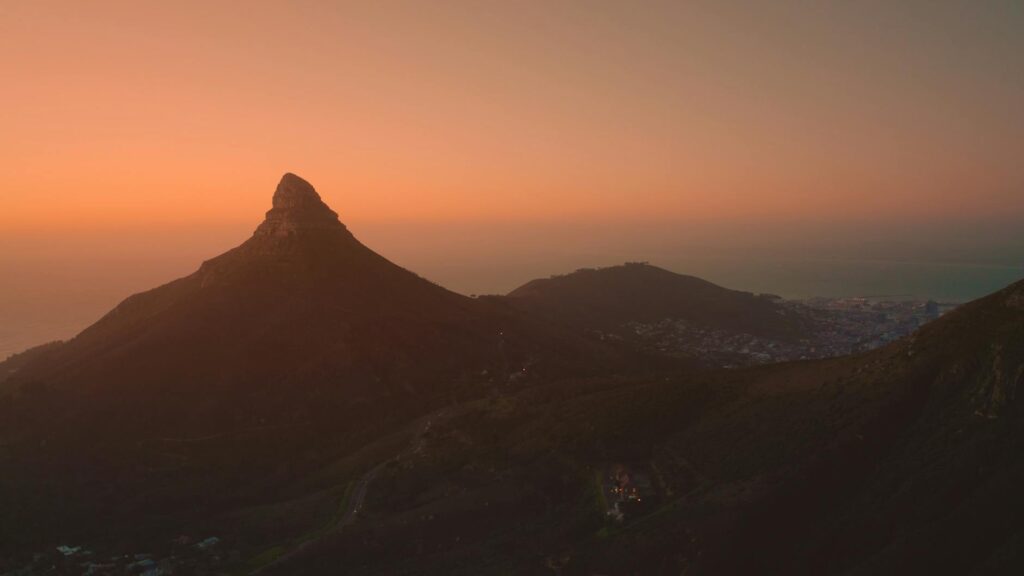
Every remote worker who lands in Cape Town ends up on Lion’s Head eventually. It sits inside the city, close to the flats of Tamboerskloof and Gardens, short enough to do before a 9am stand-up, and high enough that you come down feeling like you have done something with your morning. The catch is that the internet has flattened it into a single glossy photo of someone in activewear holding a flask, and that photo leaves out most of what matters: the wind, the chain ladder queue, the parking scrum on full moon nights, and the fact that the descent is what actually wrecks your legs.
We have done this hike in every version. Alone at 4am in winter. With twenty people on a full moon. In a south-easter we should not have been on the mountain in. So this is the playbook we wish someone had handed us in week one.
Why sunrise and not sunset
Sunset gets all the Instagram traffic, and for good reason. It is warmer, it is social, and you can drink a beer at the top. But sunset is the problem. The path turns into a single-file conveyor belt from about 5pm in summer, the chain ladder backs up, and you come down in the dark surrounded by people who did not bring a headlamp.
Sunrise is the opposite. You share the mountain with thirty to fifty other people on a weekday, most of them regulars. The light is cleaner, the wind is usually softer in the early hours, and you are back at your desk by 9am with something in your body that no flat white can replicate. It also gets you out before the south-easter fills in, which in the summer months is the biggest variable on this hike.
The route
You park on Signal Hill Road, somewhere between the main trailhead and the Signal Hill viewpoint. In summer the closest bays fill up fast, even at 5am. Do not double park, do not block driveways, and do not leave anything visible in the car. We cover the wider question of car safety in our Cape Town safety guide, but the short version for this trailhead is: empty boot, nothing on the seats, and pick a spot with other cars around it.
The trail starts as a wide gravel spiral that wraps the mountain clockwise. For the first twenty minutes it is almost too gentle, which lulls people into the wrong pacing. Then you hit the fork. Left is the chain ladder and staple route, the direct line up the rock. Right is the walk-around, which loops behind the peak on a more gradual path and rejoins near the top. The walk-around adds ten to fifteen minutes and zero technical difficulty. If you have a dodgy knee, a fear of exposure, or you are hiking with someone who does, take it without a second thought.
The chain ladder is not actually a ladder. It is a short scramble up rock with metal staples and two chains bolted in as handholds. In dry conditions it is a three minute section. In a queue on a full moon night it can be twenty minutes of waiting in the cold.
Fitness reality
Here is the honest version. Lion’s Head is 45 to 75 minutes up for a reasonably fit person who walks or runs a couple of times a week. It is 30 to 45 minutes down. It is not an easy hike and anyone who tells you it is has forgotten what their legs felt like the first time.
The climb itself is short, just over 300 metres of vertical, but it comes in quick bursts with uneven rock and step-ups that find muscles you do not use at a desk. If your whole fitness life right now is walking to the coffee shop in Tamboerskloof, you will make it, but you will feel it the next day.
The descent is where people get hurt. Your quads are gassed, the light is now bright, and the same rock steps you bounced up feel twice as high on the way down. Take the descent slower than you want to. Poles are overkill for most people but if you have knees with a history, bring one.
The full moon hike tradition
Once a month, on the night of the full moon, Cape Town does a thing. Hundreds of people, sometimes more than a thousand, walk up Lion’s Head together to watch the moon come up over the city and the sun drop into the Atlantic at roughly the same time. There is no official organiser. It is just a tradition. Locals, students, nomads, tourists, dogs, the occasional guy with a speaker in a backpack.
If you do one full moon hike, do it early in your Cape Town stint. It is the single fastest way to feel part of the city.
A few practical notes. Parking on Signal Hill Road is chaos from about 4pm on full moon day, and the overflow runs back to the Tafelberg Road junction. Get there by 3.30pm or walk up from Kloof Nek. The path is a slow procession, not a hike, so do not plan on pace. The descent in the dark on full moon nights is the one time we always bring a headlamp even with moonlight, because the queue on the chain ladder going down is where ankles get rolled.
What to bring
Headlamp is non-negotiable for a sunrise hike. Phone torches die, slip out of your hand, and light the ground wrong. A cheap 200 lumen head torch is fine. We keep a list of the ones we actually use in our kit reviews.
Water: 500ml to one litre. You are out for under two hours. Light layers: a breathable base, a fleece or long sleeve, and a wind shell you can shove in a small pack. The wind shell is the most overlooked item. The top of Lion’s Head can be fifteen degrees colder than the car park once the south-easter is up, and you will be standing still for twenty minutes at the summit.
Shoes: trail runners or a grippy sneaker. Anything smooth-soled is a bad idea on the rock. No sandals. No Crocs, even the sport ones.
When not to go
Three conditions should turn you around before you start the car.
Fire ban days. In peak summer the city issues fire restrictions and outright bans on Table Mountain National Park. Lion’s Head falls inside the park. Check the SANParks notices before a summer hike, not after. A fire ban day is usually also a wind day, and the two together are the worst combination.
Extreme south-easter. Cape Town’s summer wind is not a breeze. When it is pumping at 60 to 80km/h at sea level, it is significantly worse on the exposed top of Lion’s Head, and the chain ladder section turns into a place where people get knocked off balance. If the cypress trees in Tamboerskloof are bending double at 4am, skip it. Go to the CBD and Gardens for a coffee instead and come back tomorrow.
Wet rock on the ladder. After overnight rain or heavy mist, the staples and rock at the chain ladder get slick. Take the walk-around or reschedule.
Safety and the solo question
This is where we try to be honest rather than reassuring. Lion’s Head at sunrise is one of the more social places you can be alone in Cape Town. You are almost never isolated on the trail in the hour before sunrise. We have hiked it solo many times. Morning crime incidents on the path are rare but not zero, and they tend to happen on the lower spiral in the pre-dawn dark rather than higher up.
The practical answer: go with someone for your first two or three hikes until you know the trail, then make your own call. Do not hike with headphones in both ears. Do not flash an expensive phone on the lower path. Park where other cars are parked. If you are new to the city entirely, read our broader safety guide before you form an opinion from a single Reddit thread.
After the hike
You will be hungry and your legs will be shaking. The best move is a flat white and something with eggs within a ten minute drive. Kloof Street and upper Tamboerskloof have the densest cluster of early-opening cafes, and most of them are running by 7am. Drink more water than you think you need. Stretch your calves before you sit down at your desk, not after.
If Lion’s Head has activated the hiking bug, the next step is picking from the longer routes on Table Mountain itself. We keep a running set of opinions on which ones are worth your time in our Table Mountain route picks.
The verdict
Lion’s Head is worth it. Do it in your first three weeks in Cape Town, do it at sunrise, and do it on a day that is not a fire ban or a screaming south-easter. Bring a headlamp and a wind shell, take the walk-around if the chain ladder is backed up, and go slower on the descent than your ego wants to.
Bookmark this page, check the wind forecast the night before, and put it on the calendar. It is the hike that makes the rest of your Cape Town stint make sense. For the broader picture of what else is worth your time outside the flat, start at our explore index.
Tools we trust
Partners we use and recommend, tested in Cape Town.
We may earn a commission on purchases made through these links, at no extra cost to you. We only recommend products and services we actually use.