Muizenberg is where most Cape Town surfers catch their first wave. Not because it’s trendy or Instagram-famous, but because the conditions actually suit a beginner. The beach shelves gently, the bottom is sand, and False Bay’s water runs a few degrees warmer than the Atlantic side. The swell here is consistent enough to be useful but small enough to be manageable. On any given morning at Surfers Corner, you’ll see clusters of people learning. A lot of them stand up.
This isn’t a secret anymore. Still the best place to start.
Why Muizenberg
The setup is beginner-friendly in ways other Cape Town breaks aren’t. Sand bottom means you’re not slicing your feet open on reef. Waves crumble and reform rather than hollowing out violently, giving you multiple chances to catch them. Water temperature hovers around 18–22°C in summer and 12–16°C in winter — cold but survivable. The Atlantic side stays noticeably cooler, sitting at 10–14°C in winter and only reaching 14–18°C in summer. False Bay’s warmth is one of Muizenberg’s quiet advantages.
Infrastructure matters too. Five or six surf schools cluster within a 200-metre stretch of Beach Road, board rental shops alongside them. Walk up the beach, compare prices, decide in five minutes. No drive to a remote break. No hunt for a guide.
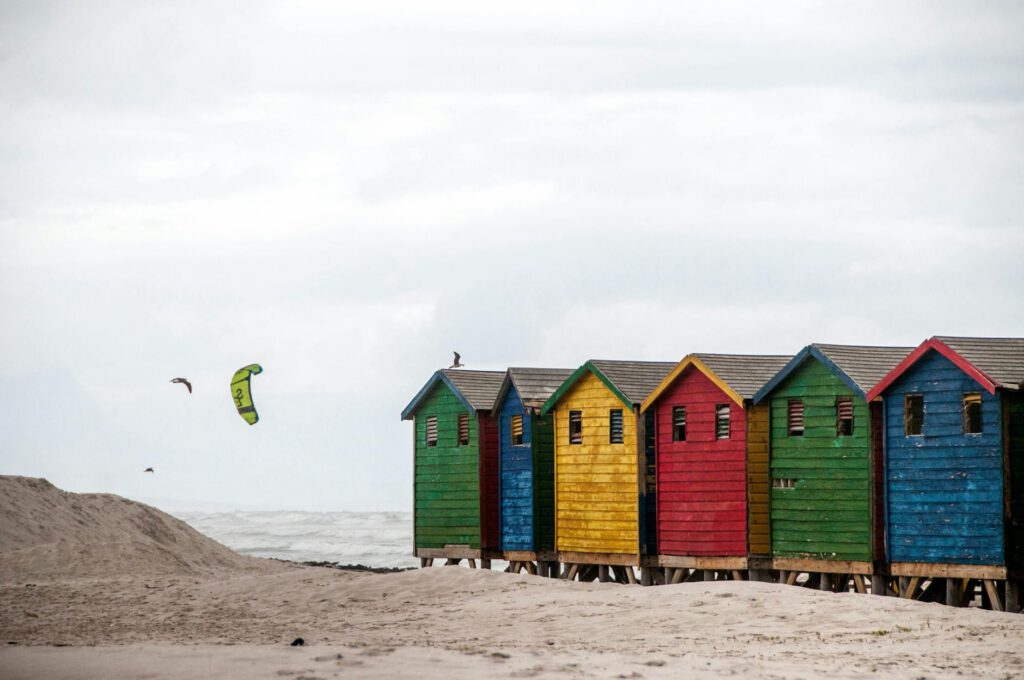
The scene has something to do with it. Surfers Corner has character — the colourful beach huts, the mix of locals and tourists, the feel that this is where learning actually happens. It’s not a serious wave. It’s social. That matters when you’re nervous about your first lesson.
Logistically, it works. From the City Bowl, 25 minutes. Parking within walking distance. Lesson, lunch, back home by early afternoon. For a visitor, that’s accessible enough to fit into a weekend trip.
When to go
Summer (October to April) is the standard recommendation for beginners. Water temperature peaks at 18–22°C — bearable in a 3/2mm wetsuit. Swell is smaller and consistent, usually waist-to-shoulder-high most days. Winter brings overhead slop you don’t need yet. The trade-off is wind. The southeaster typically kicks in around 11am, turning the face choppy and the paddle-out harder. Get there before 9am for clean conditions.
Summer is busy. Weekends at Surfers Corner can feel rammed, especially December and January. Weekdays are quieter.
Winter (May to September) brings bigger swells and colder water. You’re in 4/3mm or 5/4mm territory, water at 12–16°C. Waves are more powerful and less forgiving, but quality improves — swell more organised, wind lighter. Intermediates do better than beginners here, but it’s rideable. Bonus: fewer people.
Best time of day: Early morning, always. 7am to 9am. Water is calmest, light is best, wind hasn’t picked up. Surf schools run sessions at this time for exactly this reason.
Weekdays vs weekends: Tuesday to Thursday mornings are noticeably less crowded. If you have flexible hours, go then.
Getting there
By car: From the City Bowl, take the M3 south towards the Southern Suburbs, then switch to the M5 towards Muizenberg (or stay on the M3 and pick up Rhodes Drive, which feeds into Main Road). 20–30 minutes depending on traffic. Head toward the beachfront and turn onto Beach Road. Street parking along Beach Road or in side streets — free, but spaces fill fast. On weekends before 10am, arrive early or accept a 10-minute walk. SnapScan and Zapper are installed at some bays; bring coins as backup.
By train: The Southern Line from the City Bowl terminates at Muizenberg station. Surfers Corner is a 5-minute walk. Service has been unreliable historically — check the Metrorail app or local news first. When it’s running, it’s the easiest option and removes parking stress entirely.
By Uber or taxi: Expect R150–200 from the City Bowl. Removes the parking question.
Where to learn to surf
You’ll base yourself at Surfers Corner, the epicentre of Muizenberg surfing. Five or six legitimate schools operate here, all capable of getting you on a wave in one session.
Surf Emporium is the largest. Private lessons run R535 for one person, R480 per person for two, R450 for three, or R370 per person for a group of four or five — all 1.5 hours, all including board, wetsuit, and instruction. If you’re planning more than one session, they run a pay-for-three-get-the-fourth-free package (R1,605 solo, R1,440 per person for two). They’re professional and well-organised — you know what you’re getting. Prices valid March 2026 to February 2027. 72 Beach Road. 021 788 8687.
Gary’s Surf School has been running since 1989 — the oldest surf school in South Africa. The format is a bit different from the others: the group lesson is R800 for 2 hours (1 hour coached, 1 hour free practice on your own), which is good value if you want more time in the water. Private 1-on-1 is R1,300 for 1 hour — the most expensive option on the beach, but you get undivided attention and your own pace. All lessons include board, wetsuit, and instructor. +27 21 788 9839.
Surfshack charges R450 for a single session. Smaller and less formal than Emporium, faster lesson pace, flexible packages.
Africa Surf School runs at R800 private, R700 mini-group, R600 larger group — all 1.5 hours. Higher price reflects dedicated one-on-one attention.
What happens: Your first lesson starts on the sand. The instructor teaches you to pop up — from lying flat to standing — on a board. You’ll practise it 20 times on the beach before going near the water. Then into the whitewash about waist-deep, catching broken waves. Most people stand up on their first session. It’s awkward and you’ll fall often, but the instructors are used to total beginners and they’re good at breaking it down.
Which school? If budget is the constraint, Surfshack (R450) is the outright cheapest, and Africa Surf School’s group rate (R600) is the next best. Surf Emporium splits the difference — group rates bring the per-person cost down and they’re well-organised. Gary’s group lesson (R800 for 2 hours) is pricier but gives you an extra hour in the water, which counts when you’re starting out. For private coaching, Gary’s (R1,300/hr) and Africa Surf (R800/1.5hrs) are your options — both justify the price with focused attention. One lesson won’t make you a surfer. Three or four will.
Where to rent a board
Once you’ve had a few lessons and want to paddle out alone, rent a board. Don’t buy one yet. You’re still learning what you like.
Lifestyle Surfshop has operated since 1975. Board rental is R130 for two hours, wetsuit R90, both for R200. Right on the beachfront. They stock soft-top longboards — what you want as a beginner. More volume, more forgiveness. Slower than hard boards but they keep you on more often.
Surf Emporium also rents. R120 for board, R100 for wetsuit. Same soft-top stock.
Africa Surf School rents board and wetsuit together for R300 per 1.5-hour slot — pricier than the other options, but worth knowing if you’re already on their patch.
Rent a soft-top longboard, usually 7–8 feet. Not a shortboard. Shortboards have less volume, sink faster, demand better technique. You’ll spend the session on your back wondering why you thought this was fun. Longboards are slower but more forgiving. More waves, more time riding.
The safety stuff
Shark spotters: Muizenberg has a dedicated shark spotting programme. Spotters sit on the mountain above the beach with binoculars and radios. The flag system: green means spotters on duty, no sharks sighted. Black means spotters are on duty but visibility is poor — proceed with caution. Red means a shark has been spotted recently; leave the water or wait about an hour. White with siren means a shark is in the water right now — get out immediately. No flag means no spotter on duty, so you’re unmonitored. Respect the flags. If it’s red or white, don’t argue.
Are sharks a real risk? Great whites and other species are present in False Bay. The spotting programme is active during peak hours and it works — it’s been running for years and has prevented incidents. Actual risk of an encounter is low if you follow the rules. Don’t surf alone at dawn or dusk. Don’t paddle far beyond the flags. Stay within the managed zone.
Currents: Muizenberg is gentler than other Cape Town beaches, but rip currents can form, especially after heavy swell. If you feel yourself being pulled out and can’t paddle back, don’t fight it. Swim parallel to shore until you’re out of the current, then paddle in. Instructors will brief you on this. Listen.
The bottom: Sand. Not reef, not rock. You’re not cutting your feet. Worst case is scuffed knees on your own board.
After the water
Tiger’s Milk sits right on the beachfront. Pub food, serviceable burgers and fish, decent beer. Touristy but honest — people go to sit and watch the beach. Your post-surf beer destination.
Knead is a bakery and café up on Main Road near Surfers Corner. Good coffee, solid pastries. Pop in before or after a lesson.
The Main Road strip between Surfers Corner and the station has grown over the last few years. More cafés, some independent restaurants, surf shops mixed through. Not fancy but it has character — more artsy and bohemian than the polished Atlantic Seaboard.
The beach huts are unavoidable. Colourful structures built by Cape Town Municipality from 1929 onwards, restored and maintained over the decades. They’re the most photographed thing on the beach. Also functional — locals rent them for the day or season, and they’re a small part of Muizenberg’s identity. Worth knowing about even if you skip the photo.
What to bring
Wetsuit: Non-negotiable. Cape Town’s water is cold. Muizenberg is on the False Bay side, a few degrees warmer than the Atlantic coast, but you’re still at 18°C in summer and 12°C in winter. A 3/2mm wetsuit works most of the year here. On the Atlantic side — Camps Bay, Llandudno — you’d want a 4/3mm minimum. Surf schools provide the right suit if you’re renting. Buying your own? 3/2 is the call for Muizenberg. Rental usually R90–100 separate from lesson packages.
Sunscreen: Cape UV is aggressive even on overcast days. SPF50, reapply after the water. Reef-safe if you can find it — False Bay benefits.
Towel: Essential and often forgotten.
Parking change: Some bays are metered. Keep coins or download Zapper/SnapScan for the QR codes.
Water bottle: You’ll dehydrate faster than expected, especially in summer.
What not to bring: Expensive sunglasses — leave them locked in the car. Anything you’d be gutted to lose. Lockers aren’t always available and theft happens. Keep your car clean, valuables invisible.
Go book a lesson
That’s the first step. Choose a school — Surf Emporium for professional and organised, Gary’s for old-school, Africa Surf or Surfshack to shop around — pick a morning, show up. Bring a towel, wear sunscreen, give it three hours from car to departure. The water’s warmer than you think. You’ll stand up. If not on the first session, on the second.
Tools we trust
Partners we use and recommend, tested in Cape Town.
We may earn a commission on purchases made through these links, at no extra cost to you. We only recommend products and services we actually use.