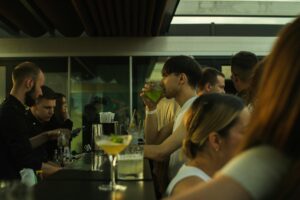
Shisa nyama is one of the few meals in Cape Town you’ll still remember a year after you’ve left. It’s also one of the experiences nomads most often get wrong: treating it as a bucket-list tick, turning up with a camera instead of an appetite, or skipping it entirely because the blogs made it sound complicated. We want to fix that. This is how to show up right, where to go in 2026, and what it actually costs.
What shisa nyama actually is
Shisa nyama is isiZulu for “burn the meat”. In practice, it’s a butchery with a fire attached. You walk up to the counter, look at what’s in the fridge, point at what you want (boerewors, lamb chops, rib-eye, chicken, offal if you’re into it), pay by weight, and hand it to the people working the grill. Ten or fifteen minutes later someone calls out and your meat arrives on a board, charred and salted and ready to eat with your hands.
You order your sides separately. That usually means pap (stiff maize porridge, the staple starch across most of Southern Africa), chakalaka (a spiced tomato and bean relish that sits somewhere between salsa and stew), maybe a bowl of samp and beans, maybe a chunk of steamed bread. You sit down at a communal table, often outside, usually with a Black Label or a Savanna in hand, usually with music loud enough that you’ll be leaning in to talk.
That’s the whole thing. It’s a weekend ritual in townships across South Africa, it’s where families eat after church, where friends catch up, where birthdays happen. It is food and community, not a performance. One thing worth clearing up before you start asking around: Mama Africa on Long Street in the City Bowl is a completely different kind of venue. It’s a long-running tourist restaurant with live music, a good spot for a drum solo and a game platter, but it is not a shisa nyama and nobody in Langa would describe it as one. And if an internet search throws Sakhumzi at you, that’s in Vilakazi Street in Soweto, Johannesburg, about 1,400 kilometres from here. Different city, different scene.
Mzoli’s: the honest read
If you’ve read anything about shisa nyama in Cape Town, you’ve read about Mzoli’s Place in Gugulethu. For close to two decades Mzoli Ngcawuzele’s butchery was the Sunday institution. Then in 2021 it closed, and it has not reopened. A venue called Teez Lounge now trades from the same address on NY 115. It is not Mzoli’s. If anyone still tells you to “go to Mzoli’s this Sunday”, they’re working off old information.
There are better places to eat now anyway. The Mzoli’s of 2018 was already more tour-bus stop than neighbourhood butchery. Its loss is cultural, but the shisa nyama scene in Cape Town did not end with it.
Where we’d actually send you
Nomzamo Butchery (Langa). 1509 Washington Street. This is the one we’d start with. It’s one of the oldest butcheries in Langa, family-run across generations, and it runs as a working butchery first and a shisa nyama second, which is exactly what you want. Open Monday to Friday 07:30 to 18:30, Saturday and Sunday 08:30 to 21:00. Weekend afternoons are the sweet spot. About a twenty-five minute drive from the City Bowl outside traffic.
GQ Gugulethu. On Dr Moerat Street. Popular with locals for the lounge, the music, and the grill. It’s livelier in the evenings than Nomzamo and leans younger. Worth a trip if you’ve already done one shisa nyama and want a different tempo.
Eziko Restaurant (Langa). Corner of Washington and Jungle Walk. This is a slightly different proposition, a sit-down traditional restaurant attached to a long-running cooking school founded by former Langa teacher Victor Mguqulwa in 1996. Not a pure shisa nyama in the butchery-counter sense, but the grilled meat, samp, and umngqusho are excellent and the room is calm enough for a conversation.
4Roomed eKasi Culture (Khayelitsha). Abigail Mbalo’s place, built around the layout of a classic four-roomed township house. Again, not a shisa nyama in the strict sense, it’s a set menu sit-down dinner, but if you want a serious meal rooted in Xhosa cooking from one of the country’s most respected chefs, this is it. Book ahead. Dinner is a fixed family-style menu and seats go.
Going with a guide, or going on your own
For a first visit, we’d go with a guide. Not because the townships are dangerous to walk into, the specific venues above welcome visitors every weekend, but because a guide gets you past the tourist layer and into the meal as it’s actually eaten. You’ll meet the butcher, you’ll understand what you’re ordering, and you’ll end up at a table with people you’d never meet in a Kloof Street bar.
Two operators we rate:
- Uthando (Love) South Africa. A non-profit, Fair Trade in Tourism certified since 2011. Their tours are built around community development projects rather than drive-by sightseeing, and they’ll route a shisa nyama stop into a broader day if you ask. Half-day tours run roughly R1,400 to R1,900 per person depending on group size. Always confirm current pricing when you book.
- Coffeebeans Routes. Founded by Iain Harris. Their storytelling and jazz-night routes are closer to “spend the afternoon with a local musician or chef” than a tour, and they’re one of the few operators we’d send a friend to without caveats.
Going solo is completely reasonable at Nomzamo or Eziko once you’ve done it once. Take an Uber rather than driving (parking is fine, but after a beer or two you’ll want the ride home), go in daylight hours on your first visit, and tell the butcher it’s your first time. They’ve seen hundreds of nomads and they’re generous with first-timers.
How to order and eat
Walk to the butchery counter. Ask what they’d recommend. A reasonable first order for two people is around 500g to 700g of meat in total, usually a mix of boerewors, lamb chops, and either rib-eye or chicken. Expect to pay roughly R150 to R250 per person for meat, plus R40 to R80 for sides, plus drinks. Some venues add a small “grilling fee” per kilo. Cash still matters at some spots, so draw a few hundred rand before you go. Nomzamo and GQ both take card in our experience but it’s not worth being the person who can’t pay.
When the meat arrives it’s on a shared board. You eat with your hands, you tear the pap with your fingers, you scoop chakalaka onto the pap, you pass things around. There is no ceremony. If you’re unsure, watch the next table for thirty seconds and copy them.
Etiquette that matters
- Turn up hungry. Leaving food on the board reads as rude.
- Tip the grill staff directly, generously, in cash. Ten percent minimum, more if someone walked you through your order.
- Do not photograph people without asking. This includes the butcher, the grill, the family at the next table, and the street outside. Ask, and accept a no.
- The venue is a community space before it is a destination. Keep your voice at the volume of the room.
- Xhosa is the first language for most people you’ll meet at these venues. A “molo” (hello) and “enkosi” (thank you) go a long way and are not performative if you mean them.
The hard parts we’re not going to hide
Drive times are real. Langa is twenty to thirty minutes from the City Bowl outside rush hour, Gugulethu a bit more, Khayelitsha about forty-five. Budget for the Uber both ways. Some venues are cash-preferred. Evenings are louder and more local, which is wonderful but means you’ll be the only visitor in the room, so go in the afternoon the first time if that feels like a lot. And the week after load shedding bites hard, some smaller spots run on gas and generators, so a quick WhatsApp to confirm opening is never wasted.
What we’d actually do this Sunday
Book a half-day with Uthando or Coffeebeans Routes, ask them to end the day at Nomzamo in Langa, bring cash, bring an appetite, leave the camera in your bag for the first hour. If you come out of it with one new WhatsApp contact and a full stomach, you’ve done shisa nyama right.
For more on meeting people here once the meal is over, see our guide to making local friends in Cape Town. If you want a broader view of how and where to eat across the city, Cape Town’s food markets is a good companion piece. And for the practical safety context that applies to any cross-city trip, our Cape Town safety guide covers the basics. More Connect pillar guides here.
Tools we trust
Partners we use and recommend, tested in Cape Town.
We may earn a commission on purchases made through these links, at no extra cost to you. We only recommend products and services we actually use.