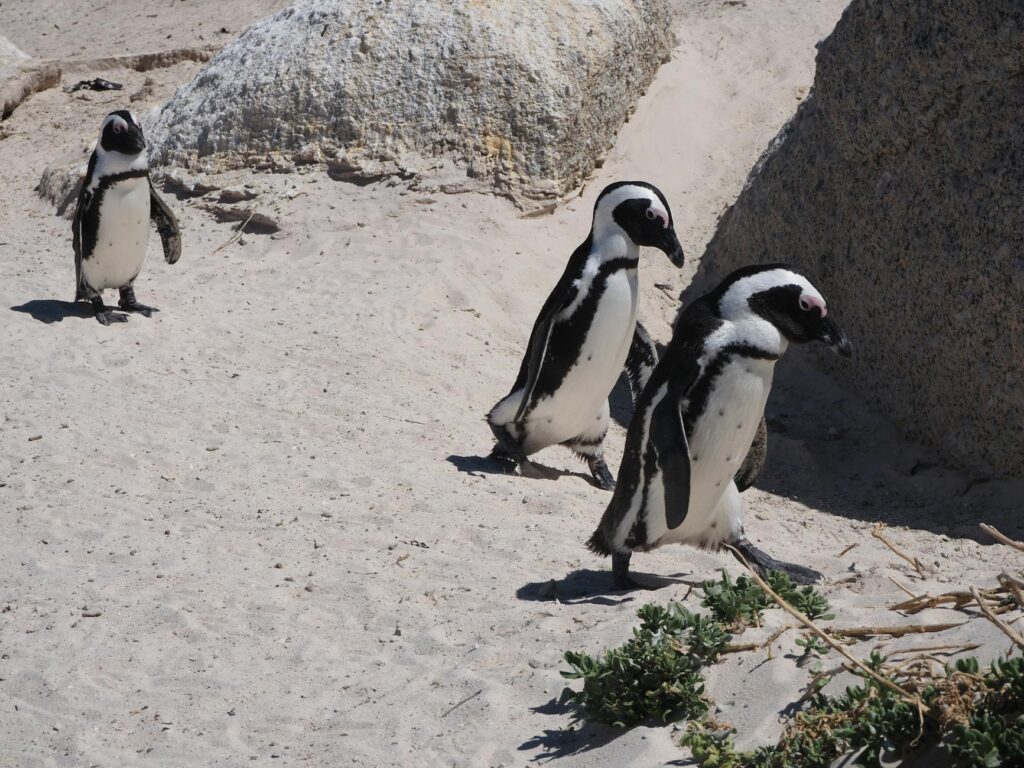
Boulders is one of the few places left where you can stand about two metres from a wild African penguin colony and watch them do absolutely nothing of note, which is the whole point. It is also, most days between 11am and 2pm, a stationary queue of tour coaches offloading people in visor hats. The colony is worth it. The tour-bus version of the colony is not. This guide is how we do it.
Where Boulders actually is
Boulders sits on the False Bay side of the Cape Peninsula, tucked into the granite coves just south of Simon’s Town. From the Cape Town CBD it is roughly 40 to 50 minutes by car on a clean run, longer if the M3 is grumpy or if you hit Muizenberg on a hot Saturday. You drive through Muizenberg, St James, Kalk Bay, Fish Hoek, then the winding coastal stretch into Simon’s Town. Boulders is about two kilometres further south, past the naval base.
It is managed by SANParks as part of the Table Mountain National Park Marine Protected Area. That matters for two reasons. First, you pay a conservation fee at the gate. Second, this is not a zoo. The penguins are wild, they go where they want, and the boardwalks and fences are there to keep you out of their nesting zone, not the other way around.
The two entrances, and why it matters
Most first-timers do not realise there are two separate access points to the same colony, about 800 metres apart, and they offer completely different experiences.
Boulders Beach main entrance (the boardwalk). This is the one most tour buses use. You pay your SANParks fee, walk through the visitor centre, and the wooden boardwalk snakes out over the dune scrub and past the main nesting area at Foxy Beach. This is viewing only. You do not get into the water here, and the penguins are below you, going about their business in and out of the brush. It is the best place to actually see the colony at density.
Seaforth. A short drive or 10-minute walk north, Seaforth is the swimming beach inside the protected cove. You still pay the SANParks fee at the gate, but here the penguins wander across the sand and waddle past swimmers. It is the only place in the park where the fence between humans and penguins quietly dissolves. If you want the “I swam next to a penguin” photograph, Seaforth is where it happens. The water is sheltered, usually flat, and often a few degrees warmer than the Atlantic side.
Our move: park at Seaforth, swim or wade for an hour, then walk the short path to the main boardwalk for the colony density shot. One fee, two experiences, no tour-bus bottleneck.
Timing is the whole game
There is a penguin visit and there is a Boulders tour-bus visit, and the difference is a 90-minute window. Coach traffic rolls in from roughly 10:30am and peaks between 11am and 2pm. If you arrive at 8am when the gate opens, or after 4pm once the coaches have left, you will see the same colony with maybe a tenth of the people.
Early morning is the better version. The light is low, the penguins are more active after the overnight cool, and the boardwalk is nearly empty. Late afternoon works too, especially from October to March when sunset is late and the light on the granite boulders turns copper around 5:30pm. We avoid midday entirely unless it is the only option, and if it is, we skip the main entrance and go straight to Seaforth where the crowds dilute into the swimming beach.
Cost and access
SANParks adjusts conservation fees each November. As of April 2026 the Boulders day fee is R180 per adult for international visitors and R90 for South African ID holders, with reduced rates for SADC nationals. Under-12s are around R90. If you have a Wild Card (the SANParks annual pass), entry is free, and if you are doing more than two national park visits during your time in Cape Town, the Wild Card pays for itself quickly.
Card payment is now standard at both entrances, but the machines do occasionally go offline. We always keep a couple of hundred rand in cash as a backup. There is no booking system. You rock up, you pay, you walk in.
What you actually see
The colony numbers fluctuate, but it has been sitting around 2,000 to 3,000 birds for the last few seasons. They live in the dune scrub above the beach, in wooden nesting boxes installed by the conservation team, and in whatever gaps in the fynbos they can burrow into. You will see adults on guard duty, juveniles testing out the water, and during the right months, fluffy grey chicks that look like tennis balls with attitude.
One thing worth knowing: the annual molt runs roughly August to October. During molt, penguins shed and regrow their feathers over about three weeks and cannot enter the water. The colony looks thinner because the non-molting birds are out at sea feeding. If you visit in September you will still see plenty of birds, but do not expect the whole colony at once. Peak density is December to February when the chicks are around.
Simon’s Town on the way out
Do not drive straight back. Simon’s Town is five minutes up the coast and it is worth an hour of your day. The main street is lined with Victorian buildings from its Royal Navy days, and the waterfront at Jubilee Square has two things worth stopping for.
The first is Bertha’s, the restaurant on the jetty. It does the job for a post-penguin lunch or a sundowner, and the view over the yacht basin is the sort of thing that makes you forget about your inbox. Ask for a table on the upper deck if you can.
The second is the Just Nuisance statue in Jubilee Square, a life-size bronze of the only dog ever officially enlisted in the Royal Navy. It is a small detail, but if you do not know the story it is worth a five-minute read before you go. Locals bring their kids there on Sundays.
Lunch on the way back (the Kalk Bay option)
If you skip Bertha’s, or you fancy something scruffier and more fish-forward, push on 15 minutes north to Kalk Bay. This is our usual call. Kalky’s, tucked into the working harbour, does straight-off-the-boat hake and chips on plastic plates with no airs and absolutely no pretensions. Brass Bell, built into the rocks next to the train station, is the more sit-down version with waves breaking against the windows at high tide. Full breakdown in our Kalk Bay guide.
Pair the two and you have a solid half-day: penguins in the morning, beer and fish by 1pm, back in the city by 3.
Transport: the train question
This comes up every time. Yes, the Southern Line train from Cape Town to Simon’s Town is one of the most scenic commuter rides on the continent, hugging the False Bay coast from Muizenberg through Kalk Bay and Fish Hoek. When it runs, it is brilliant. The qualifier is “when it runs”. Service has been unreliable for years, with partial reopenings and rolling schedule changes. Check Metrorail’s current status the week you travel rather than trusting any blog post, including this one.
If the train is running, take it to Simon’s Town station, then grab a short Uber or walk the 25 minutes south along the coast road to Boulders. If the train is not running, Uber is the default: expect R280 to R350 one way from the CBD, and know that return-trip Ubers from Boulders sometimes take 10 to 15 minutes to find a driver. Most people end up driving themselves. Parking is free and usually fine at both entrances outside of peak hours.
When NOT to go
Long weekends. South African school holidays, especially December and April. Any Saturday or Sunday between 11am and 2pm from November to February. If you are visiting during one of these windows and Boulders is on the list, shift your visit to a weekday morning or skip it and do Kommetjie instead. The colony is not going anywhere.
The verdict
Boulders earns its reputation, and it earns the tour-bus swarm, and the trick is to simply not be there when the swarm is. Arrive at 8am, split your time between Seaforth and the boardwalk, drive through Simon’s Town for a look at the harbour, and land in Kalk Bay for a late lunch. That is a half-day we would happily do again, and one we build into almost every itinerary in our Cape Town nomad guide for people who have more than a week in the city. Just do not do it at noon on a Saturday in January. That one is on you.
Tools we trust
Partners we use and recommend, tested in Cape Town.
We may earn a commission on purchases made through these links, at no extra cost to you. We only recommend products and services we actually use.